

Hidden Behind Climate Policies, Data From Nonexistent Temperature Stations
Hundreds of ‘ghost’ climate stations are no longer operational; instead they are assigned temperatures from surrounding stations.
The National Oceanic and Atmospheric Administration (NOAA) predicts July, August, and September will be hotter than usual. And for those who view warmer temperatures as problematic, that’s a significant cause for concern.
“Earth’s issuing a distress call,” said United Nations secretary-general António Guterres on March 19. “The latest State of the Global Climate report shows a planet on the brink.
“Fossil fuel pollution is sending climate chaos off the charts. Sirens are blaring across all major indicators: Last year saw record heat, record sea levels, and record ocean surface temperatures. … Some records aren’t just chart-topping, they’re chart-busting.”
President Joe Biden called the climate “an existential threat” in his 2023 State of the Union address. “Let’s face reality. The climate crisis doesn’t care if you’re in a red or a blue state.”
In his 2024 address he said, “I don’t think any of you think there’s no longer a climate crisis. At least, I hope you don’t.”
When recalling past temperatures to make comparisons to the present, and, more importantly, inform future climate policy, officials such as Mr. Guterres and President Biden rely in part on temperature readings from the United States Historical Climatology Network (USHCN).
The network was established to provide an “accurate, unbiased, up-to-date historical climate record for the United States,” NOAA states, and it has recorded more than 100 years of daily maximum and minimum temperatures from stations across the United States.
The problem, say experts, is that an increasing number of USHCN’s stations don’t exist anymore.
“They are physically gone—but still report data—like magic,” said Lt. Col. John Shewchuk, a certified consulting meteorologist.
“NOAA fabricates temperature data for more than 30 percent of the 1,218 USHCN reporting stations that no longer exist.”
He calls them “ghost” stations.
Mr. Shewchuck said USHCN stations reached a maximum of 1,218 stations in 1957, but after 1990 the number of active stations began declining due to aging equipment and personnel retirements.
NOAA still records data from these ghost stations by taking the temperature readings from surrounding stations, and recording their average for the ghost station, followed by an “E,” for estimate.
The addition of the ghost station data means NOAA’s “monthly and yearly reports are not representative of reality,” said Anthony Watts, a meteorologist and senior fellow for environment and climate at the Heartland Institute.
“If this kind of process were used in a court of law, then the evidence would be thrown out as being polluted.”
NOAA’s complete record of USHCN data is available on its website, making it a vital tool for scientists examining temperature trends since before the Industrial Revolution.
Jamal Munshi, emeritus professor at California’s Sonoma State University, wrote in a 2017 paper that because many of the stations in the USHCN, and their data, date back to the 1800s, they’ve been “widely used in the study of global warming.”
“The fear of anthropogenic global warming has generated a great interest in temperature trends such that even minute changes in the temperature record are scrutinized, and controversial implications for their effects on climate, extreme weather, and sea level rise are weighed against the cost of reducing emissions as a way of moderating these changes,” Mr. Munshi wrote.
“Energy and development policy around the world are impacted by these evaluations.”
Mr. Shewchuk said the USHCN data is the only long-term historical temperature data the United States has.
“In these days of apparent ‘climate crisis,’ you would think that maintaining actual temperature reporting stations would be a top priority—but they instead manufacture data for hundreds of non-existent stations. This is a bizarre way of monitoring a climate claimed to be an existential threat,” he said.
“Observed data is real. Altered and fabricated data is not real. Period.”
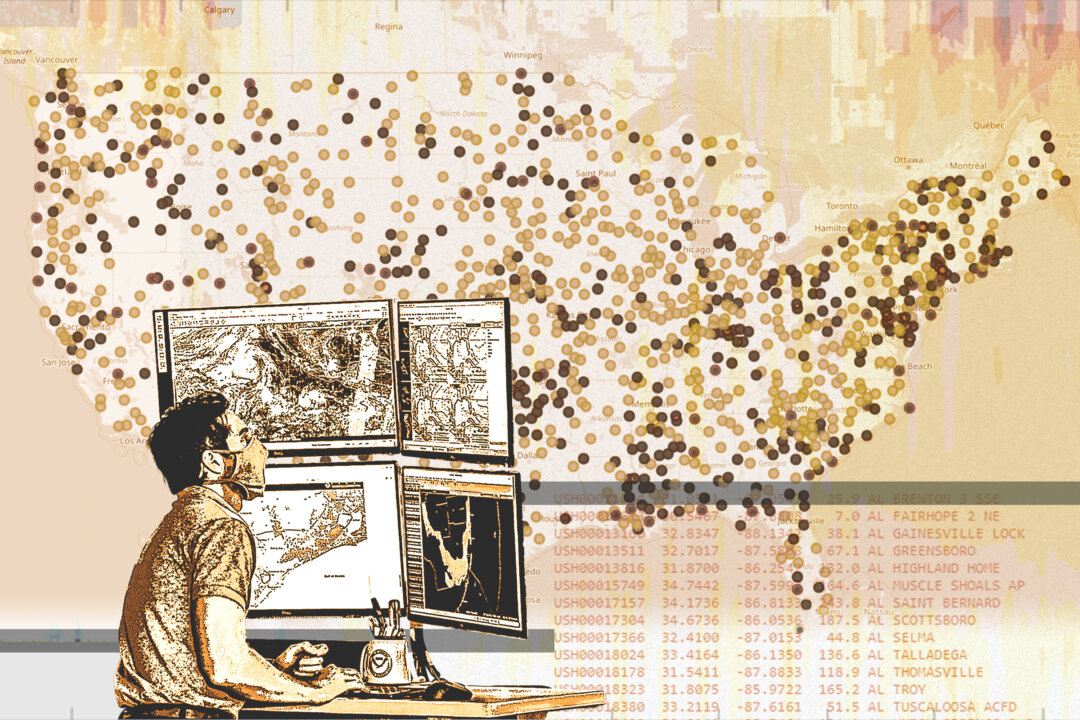
The website, noaacrappy, lists all of the ghost, or “zombie” stations, their location, how long they’ve been closed and then links to NOAA’s recordings.
Significantly, the map shows, not all of the stations used to interpolate temperature data are near the closed station. Thus, hypothetically, it’s possible that since Oklahoma City’s stations are all “zombies,” interpolation data is coming from as far away as Gainesville, Texas, which is more than 136 miles away, and Enid, Oklahoma, which is more than 100 miles away.
“For various reasons, NOAA feels the need to alter this data instead of fixing equipment problems they think exist,” Mr. Shewchuk said.
“Fixing temperature reporting stations is not rocket science. If we can go up to space to fix the Hubble telescope, we can surely come down to earth to fix a few thermometers.”
NOAA’s use of ghost temperature stations isn’t a recent phenomenon. In 2014, Mr. Watts raised the issue of ghost stations and bad data with NOAA’s chief scientist at the National Climatic Data Center, Tom Peterson, and Texas’ state climatologist, John Nielsen-Gammon, who confirmed there was an issue.
“Anthony – I just did a check of all Texas USHCN stations. Thirteen had estimates in place of apparently good data,” Mr. Nielsen-Gammon wrote in an email to Mr. Watts, according to a report on the latter’s website.
“It’s a bug, a big one. And as Zeke [Hausfather] did a cursory analysis Thursday night, he discovered it was systemic to the entire record, and up to 10 percent of stations have ‘estimated’ data spanning over a century.”
At the time, Mr. Watts reported on his climate website, “Watts Up With That,” that NOAA was taking the issue seriously and expected them to issue a fix shortly. That fix never materialized. “They’re still doing it, and it’s even worse” he said.
NOAA’s Cooperative Observer Program, which includes the USHCN stations, is a network of daily weather observations taken by more than 8,500 volunteers, its webpage states.
Mr. Watts said the process for volunteers is “labor intensive.” “It requires people to record high and low temperature, rainfall, the temperature at the time of observation, and do it at a very specific time, every day. And this has to then be recorded and sent to the National Climatic Data Center in Nashville, now known as the National Center for Environmental Information,” he said.
“Some of it’s still done on paper, some of it’s still done with touchtone over the telephone. It requires a lot of dedication and effort on the part of the observer. It’s a thankless job. And as a result, observers have been disappearing. A lot of them have left due to attrition by death. And then there’s no one to take on that job.”
Mr. Watts explained that when that happens, instead of subtracting the unmanned station from the overall number of USHCN stations, NOAA creates a number from surrounding stations.
“As a result, we end up with this milkshake of data that is basically a hot mess, and isn’t real in most cases,” Mr. Watts said.
Mr. Shewchuk said as a forensic consulting meteorologist, he produced expert witness reports for legal cases.
“I only used official ‘NOAA certified’ original weather data observations,” he said. “If I were to use ‘altered’ or ‘fabricated’ data, I would have been thrown out of court.”
NOAA’s Defense
NOAA’s National Centers for Environmental Information confirmed to The Epoch Times that it uses “ghost” station data.
As an explanation, it said, “NOAA provides estimates for missing monthly temperature values in the USHCNv2.5 dataset. The approach to estimating missing values is described in the USHCN v2 overview paper, and values that are estimated are noted with a specific flag as described in the USHCN readme file.
“This flag is used to distinguish the observed values from estimated values. This attribute of providing estimated values to create uniform periods of record for monthly temperature stations is somewhat unique to the USHCN monthly data, which has provided estimates for several decades.
“While these estimates are provided as a service to users who may benefit from the data completeness provided by USHCN, NOAA itself does not directly use the estimates for closed stations (or for early periods before the observed record begins) in its own climate monitoring activities.”
Mr. Shewchuk didn’t buy NOAA’s response.
“It’s a shell game,” he said. “The ‘USHCN’ data is now included in a variety of larger datasets of various names, so now some can officially claim that ‘USHCN’ is not being used as a single entity.
“However, all the USHCN data is actually used for all historic climate studies because the USHCN data is the only data that goes back over 100 years. Without this historical data, we are climate-change blind.”
He added, “If NOAA doesn’t use USHCN data, then why do they use our tax monies to update the USHCN data files on a daily basis? Why do they use our tax monies to periodically go back and re-alter previously altered temperature data?”
The Bigger Issue
According to Mr. Watts, ghost stations are problematic but are only part of a much bigger problem.
He explained that several different entities—such as the European Commission’s Copernicus, NASA’s Goddard Institute for Space Studies (GISS), Berkeley’s Earth Surface Temperatures (BEST), and NOAA—publish monthly and yearly climate data and advertise themselves as having “independent data.”
“That is a lie,” Mr. Watts said about the independent data claim.
“The USHCN data set and the [new] nClimDiv climate division data set [which uses the same stations and has the same problems] comes from the Cooperative Observer [Program] in the United States.
“Similarly, in the rest of the world, there is a Cooperative Observer [Program] that suffers from the same problems of attrition and incompetence. And it’s called the GHCN; the Global Historical Climatology Network.
“All these different entities out there, like NOAA, GISS, BEST, all the entities I listed, use the same data from GHCN. And they all apply their own set of ’special sauce' adjustments to create what they believe is true.
“It’s almost like each of these entities is creating their version of the real, true God. You know, it’s like a religion. They’re using different mathematical and statistical techniques to produce their version of climate reality.
“And it all goes back to the same original, badly-sited, badly-maintained ghost station dataset around the world. USHCN and GHCN are the same stuff. So, there is no independent temperature dataset. It’s bogus that anyone claims this.”
Mr. Shewchuk said the warming the earth has experienced since the 1800s is much less than has been reported, but even if it weren’t, warmer temperatures are natural—not manmade—and not a cause for concern.
“We are still thawing out from the Little Ice Age because the Bray and Eddy solar cycles are still in their warming phases,” he said. “[Carbon dioxide] is a greenhouse gas, but its contribution to today’s warming is trivial. Whenever someone asks me how much ’man-made‘ CO2 is increasing Earth’s temperature, I respond, ’Does the growth of a new eyelash increase your weight?’
“There is no climate emergency. In fact, all measures of severe weather are decreasing—even tornadoes and hurricanes. Furthermore, global warming (at least the little that there is) and increasing CO2 are good for life on Earth. History clearly shows us that life thrives during warm periods (like the Medieval Warm Period) and suffers during cool periods (like the Little Ice Age).
He pointed out that even NOAA and NASA report that increased CO2 has “greened the planet” and increased plant growth, which has benefited food production.
“We should celebrate CO2—not demonize it.
If You Love This Country, When You Vote, Consider the Policies That Islamist Sharia Ideology Demands
https://www.gatestoneinstitute.org/22938/policies-that-sharia-demands


THE GREAT RESET: I'VE CONNECTED THE DOTS. NOW CANADIANS NEED TO CONNECT THE CONSEQUENCES.
By Rich Angel | Wake Up Canada News
After years investigating Canada's gold reserves, Brookfield, Mark Carney, the World Economic Forum, our pensions, wars, digital banking and foreign ownership, I've reached a disturbing conclusion.
We're witnessing a massive transfer and concentration of economic power, and most Canadians are being shown the individual pieces instead of the entire picture.
Here's how I watched it unfold.
FIRST, THE FINANCIAL FOUNDATION.
Canada spent decades selling virtually all its official gold reserves. Our wealth became increasingly dependent on financial markets, investments and international institutions.
THEN CAME THE CRISIS YEARS.
In 2020, the World Economic Forum publicly promoted its Great Reset. Governments accelerated digital services, while the pandemic exposed how quickly emergency powers could reshape everyday life.
In 2022, the Freedom Convoy bank freezes demonstrated that access to money could be restricted through extraordinary ...