

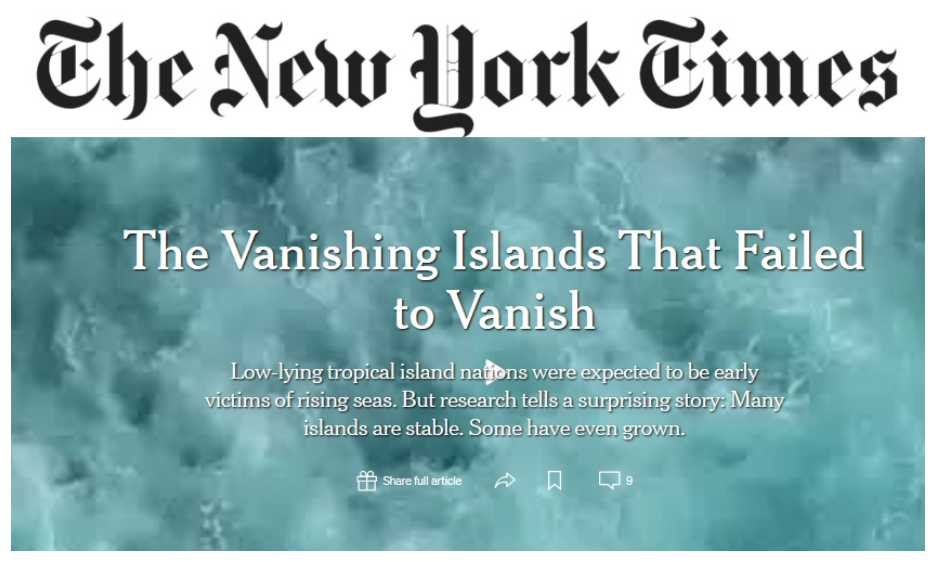
Six years later, New York Times mentions that the Maldives is not sinking
A little tiny delated backdown from extreme climate hype begins
In 2018, a study of aerial photos of 700 Pacific Islands showed that 89% were the same size or growing. This rather destroyed the idea that sea levels were swallowing small nations. The New York Times said nothing. Indeed, the only Pacific things shrinking were deserted sand drifts. No islands bigger than 10 hectares were getting smaller. Measured in square kilometers that’s “0.1”. Despite the media headlines and delegations from Kiribati and Tuvulu begging for money to hold back the tide, no islands with people living on them were shrinking. None, not one island in the Pacific big enough to matter, was disappearing. The largest 630 islands in the Pacific were had not being touched by climate change for decades.
In 2023 another study of 1,100 islands came to the same conclusion. To find that many islands they included things as small as one thousandth of a square kilometer — we’re talking about spits of sand 10 meters square. (There are whales larger than that.) The Kench team studied islands in the Indian Ocean too. In one case, they sliced, diced and drilled through one poor island in the Maldives and discovered it had a history like tossed salad. The ocean had churned and turned every part of it.
Now, six years later, the New York Times is catching up on one small part — the Maldives, they admit, are not vanishing like they were supposed to. But the Times are still not saying that the original study came out in 2018, and that hundreds of media stories on sea levels were wrong, out of dat..

THE GREAT RESET: I'VE CONNECTED THE DOTS. NOW CANADIANS NEED TO CONNECT THE CONSEQUENCES.
By Rich Angel | Wake Up Canada News
After years investigating Canada's gold reserves, Brookfield, Mark Carney, the World Economic Forum, our pensions, wars, digital banking and foreign ownership, I've reached a disturbing conclusion.
We're witnessing a massive transfer and concentration of economic power, and most Canadians are being shown the individual pieces instead of the entire picture.
Here's how I watched it unfold.
FIRST, THE FINANCIAL FOUNDATION.
Canada spent decades selling virtually all its official gold reserves. Our wealth became increasingly dependent on financial markets, investments and international institutions.
THEN CAME THE CRISIS YEARS.
In 2020, the World Economic Forum publicly promoted its Great Reset. Governments accelerated digital services, while the pandemic exposed how quickly emergency powers could reshape everyday life.
In 2022, the Freedom Convoy bank freezes demonstrated that access to money could be restricted through extraordinary ...