


THERE IS Something wrong when we are sending BILLIONS of $$ to Ukraine a war torn Country for their military BUT CANADIANS are flying there for medical treatment that WE CANNOT afford here in Canada. Could our Government explain this to tax payers please???????????
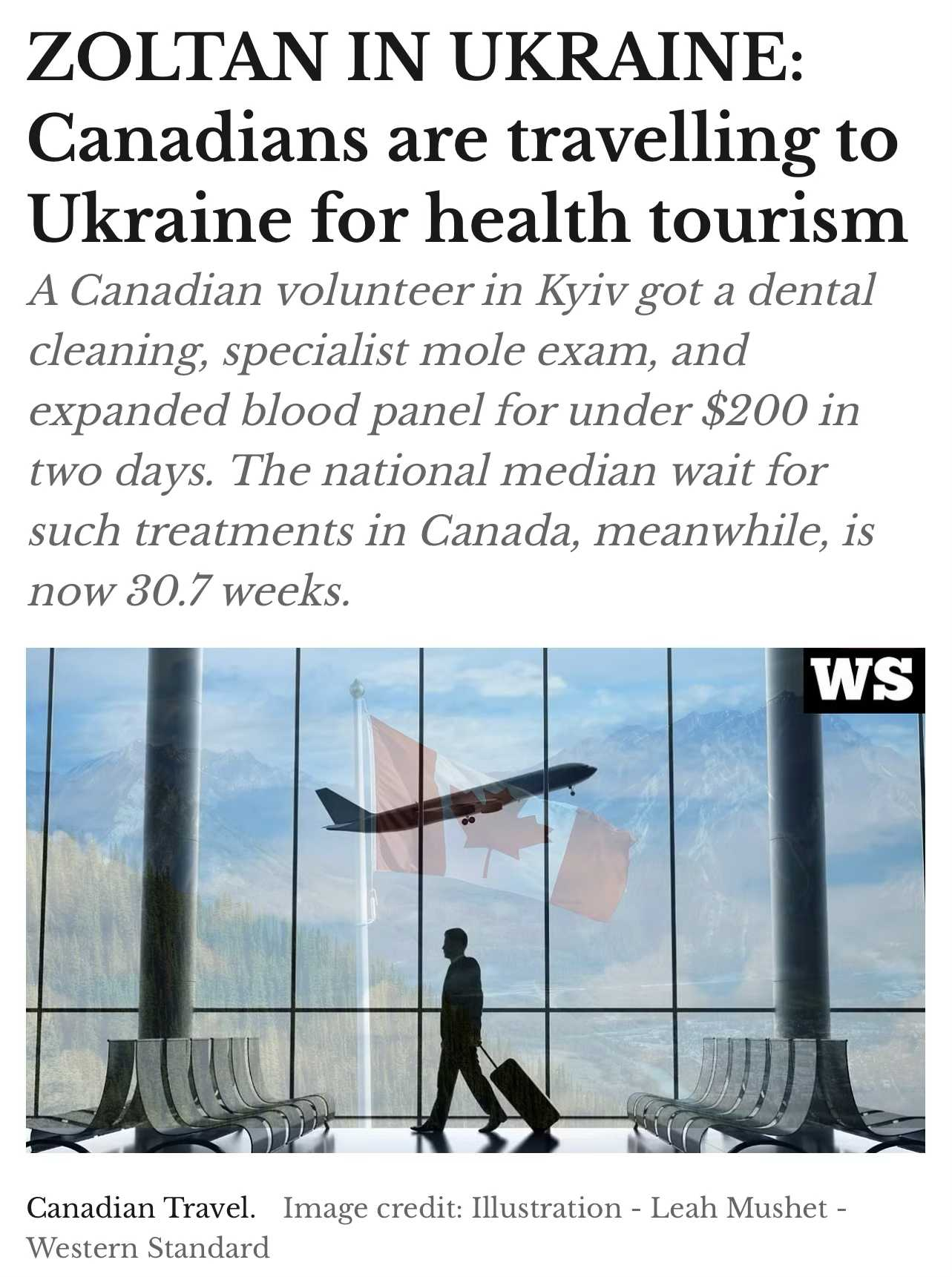
LVIV - Some Canadians are flying into a country under a Level 4 advisory to get MRIs, dental implants, IVF cycles, psychologist exams, and other medical treatments, as their own healthcare system fails to deliver back home.
While Global Affairs Canada tells them to avoid all travel because of the Russian invasion, and provincial health plans cover nothing once they cross the border, they go anyway. The calculation for many is weighing whether a half-year wait at home, or an uncovered private bill, is worse than the airspace risk and the insurance premium on the other end.
The dismal condition of Canada's government-only healthcare system is hardly a state secret at this point.
Earlier this week, Canadian expat and commentator Meghan Murphy posted on Canadian healthcare being a "massive ripoff."
She wrote that she paid into the system her entire life, barely used it, then could not get in to see a doctor and paid out of pocket for most of the services she did access — dentist, physiotherapist, massage, pharmaceutical drugs.
Murphy said people are dying on waitlists or in the ER, waiting for treatment, or being offered assisted suicide as an alternative to actual healthcare.
The clip she attached showed a conversation in which the average family contribution to healthcare was put at about $18,000 in 2024 and roughly $20,000 to $21,000 today — hardly "free healthcare," as is often claimed.
Murphy's claims aren't just qualitative or anecdotal; the numbers match the claims.
The Fraser Institute’s Waiting Your Turn 2026 report, published the same day as Murphy's post, put the national median wait from general practitioner referral to treatment at 30.7 weeks.
That is the longest figure the institute has recorded since it began tracking in 1993, when the wait was 9.3 weeks.
The 2025 median was 28.6 weeks; the 2024 median was 30.0. Ontario recorded the shortest provincial median at 22.1 weeks.
New Brunswick recorded the longest at 64.4 weeks. Orthopaedic surgery sat at 53.6 weeks nationally.
The institute estimated nearly 1.5 million procedures waiting across the ten provinces. A companion calculation for 2025 put the private cost of the queues — lost wages and productivity — at more than $4.2 billion.
Ukrainian private clinics, meanwhile, continue to market to foreigners even while the war continues.
Violetta Yanishevska, president of the Ukrainian Association of Medical Tourism, told RBC-Ukraine in December 2025 that the overall volume of foreign patients has dropped sharply since the full-scale invasion, meaning there is a positive imbalance between supply and demand for foreigners seeking healthcare.
The niches that remain competitive, she said, are dentistry (restoration, implantation and prosthetics), reproductive medicine including IVF, and cosmetic and plastic surgery.
Clinics in safer regions continue to accept foreign patients and position themselves around military-medicine expertise, rehabilitation and surgery. Exact numbers of Canadian patients are not published, but Western Standard has spoken to Canadians on the ground in Ukraine about their experience.
Billy MacDonald, a Canadian who spent months in Ukraine as a volunteer helping to repair and rebuild structures hit by ballistic missiles in Kyiv, described what he found when he decided to test the system himself.
“I always heard about the ability to access high-quality medical services in Ukraine even during war and people travel from outside and within Ukraine to cities like Kyiv or Kharkiv to get care they need or desire,” he said.
“I have been curious of how easy and inexpensive it was so after 3 years of traveling to Ukraine to do humanitarian work, I decided this time I would follow this curiosity and seek out medical exams and treatments that are hard to come by in Canada.”
Ukrainian friends told him imaging, dental work or blood tests were available without a referral.
On a day off he walked into a lab in Kyiv without an appointment, ordered an expanded blood panel that included tests for lipid particle size, kidney and liver function, APOE gene testing for an Alzheimer’s biomarker, vitamin D and a full hormone panel — several of which he said are unavailable or hard to obtain in Canada. Results arrived by email that evening.
The cost was $60 CAD. He booked a full-body mole exam with a dermatologist through an app; the appointment came in less than 24 hours.
The specialist photographed his moles, gave a consultation in English and emailed the records. That cost $80 CAD.
A dental checkup and cleaning, booked the same morning, happened that afternoon. The clinic photographed his teeth and provided records.
He had recently had hip surgery in Canada after a three-year wait; an MRI of the hip was quoted at $120 with availability within three days, though he cancelled for work.
At a pharmacy he bought five over-the-counter items suggested by his blood results for $60.
“As a Canadian, what I was able to accomplish 2-3 days for under $200 CAD to take care of my health and with little effort in Ukraine, would have taken me over a year or more in Canada with some tests unavailable to get at all,” he said. “I was astounded with the quality, service, and access – all during wartime.”
The absurdity is clear as day: a country at war is selling faster, cheaper dental and reproductive care to citizens of a country at peace that has sent more than $25.5 billion in multifaceted assistance since February 2022 and has spent decades taxing its citizens for “universal coverage" that leaves them waiting, for dangerously long periods, for the healthcare they need.

Now China produces more coal than the rest of the world combined
There’s one place on Earth where carbon emissions are irrelevant
https://joannenova.com.au/2026/11/now-china-produces-more-coal-than-the-rest-of-the-world-combined/
OTTAWA — Christianity is projected to lose its status as the majority religion in Canada by 2030, with the Muslim share of the population expected to more than triple over the next 50 years, according to new research from the Pew Research Center.
The study released Wednesday projects that Christians will make up just 33.3% of Canada's population by 2070 (down from 53.3% in 2020).
Over the same period, Muslims are projected to rise from 4.9% to 15.6% of the population (an increase of over 10 percentage points).
Canadians who identify as having no religion are also projected to become the largest religious group in the country, growing from 34.6% in 2020 to 40.5% by 2070.
The findings point to a major shift in the religious makeup of Canada, with Christianity no longer in the majority within the next four years and ultimately to be surpassed by the 'religiously unaffiliated'.
Pew projects Christians will make up 48.3% of the Canadian population in 2030 (down to 43.8% in 2040 and 39.6% in 2050).
Muslims will make up 6.7% of the ...